

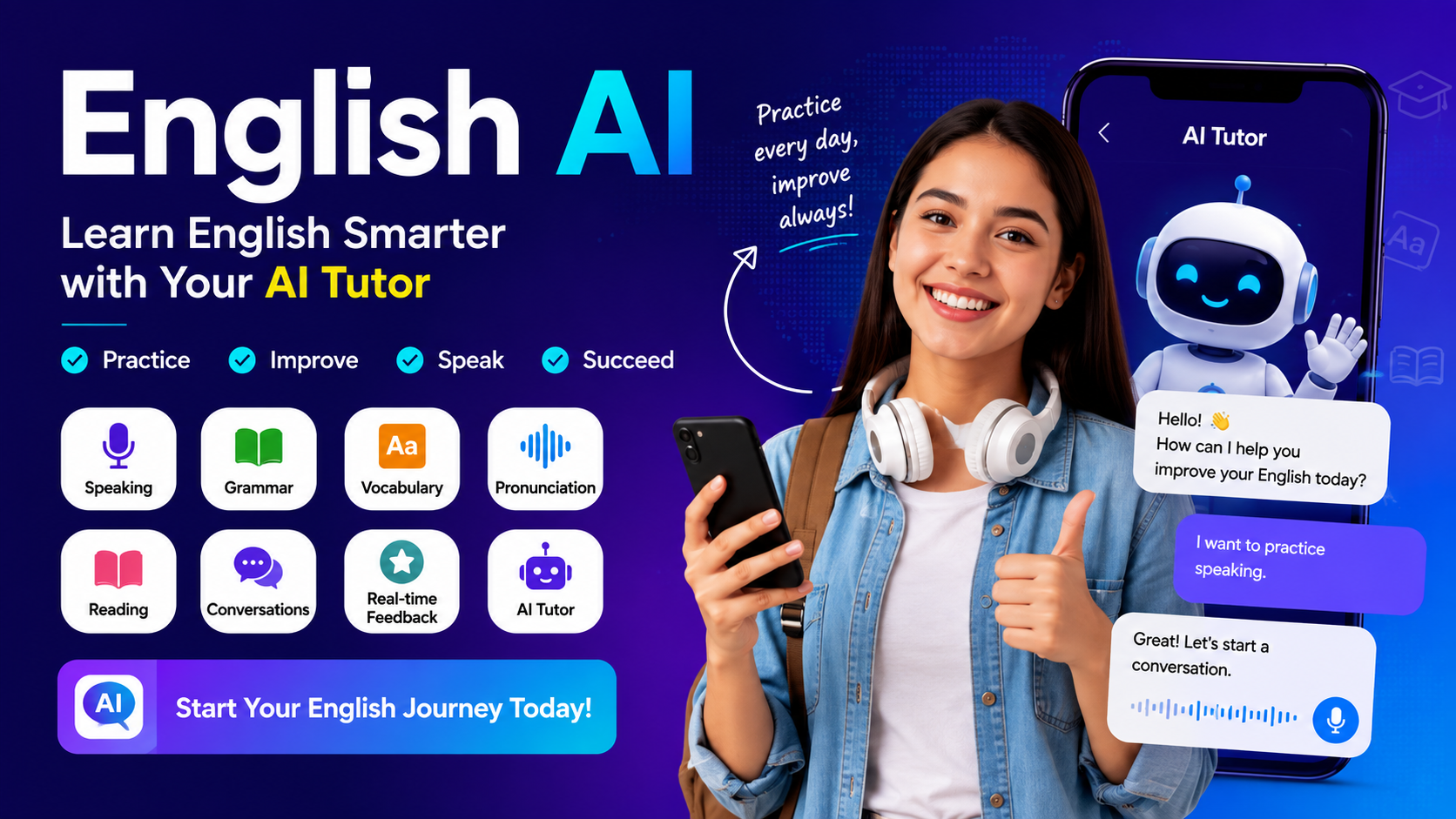
Learning English has become an important goal for students, professionals, travelers, content creators, and anyone who wants to communicate more confidently. However, traditional learning methods do not always provide enough opportunities to practice speaking, pronunciation, vocabulary, and everyday conversations. English AI provides an interactive way to practice English with an AI-powered tutor and develop language skills at your own pace.
The English AI app is designed to make English practice more convenient and engaging. Instead of only reading grammar rules or memorizing vocabulary, learners can practice different parts of the language through interactive lessons and conversations. The app focuses on important areas such as grammar, speaking, reading, pronunciation, vocabulary, listening, and conversational practice.
According to the existing app description, English AI is designed for learners ranging from beginners to advanced users and provides an AI virtual chat character for interactive English practice. It also provides real-time feedback to help users improve their speaking and vocabulary.
This complete guide explains what English AI is, how it can help with English learning, its major features, how to practice effectively, and why AI-based language practice can be useful for learners.
What Is English AI?
English AI is an AI-based English learning and practice application designed to help users improve their English language abilities through interactive practice.
Rather than treating English learning as a simple process of reading lessons and memorizing words, the app provides a more interactive learning experience. Users can practice communication, vocabulary, pronunciation, grammar, reading, and speaking while receiving assistance from an AI-based virtual tutor.
One of the main ideas behind English AI is conversational learning. The app allows learners to interact with an AI character and practice English in a way that can feel more like a real conversation.
This can be especially useful for people who understand English but feel nervous when speaking it.
English AI can be useful for:
- Beginners learning basic English
- Students improving their communication skills
- People practicing English conversation
- Learners working on pronunciation
- Users expanding their vocabulary
- People reviewing English grammar
- Advanced learners who want additional speaking practice
- Anyone who wants flexible English practice
The goal is simple: provide a convenient environment where learners can practice English regularly.
Why Is English AI Useful for English Learners?
Many people know English grammar rules but still struggle to speak confidently. Others may have a reasonable vocabulary but have difficulty creating sentences during real conversations.
This happens because knowing a language and actively using a language are two different skills.
English AI focuses on active practice. Instead of only studying information, users can interact with an AI tutor and practice communicating.
Regular practice can help learners become more comfortable with English sentences, vocabulary, pronunciation, and conversation.
Another advantage is convenience. Learners can practice whenever they have available time instead of depending completely on a classroom or a conversation partner.
For example, a student could practice English for a few minutes in the morning, review vocabulary during the afternoon, and work on speaking practice in the evening.
The important factor is consistency.
English AI Features
The usefulness of an English-learning application depends heavily on its learning and practice features. English AI brings several language-learning areas together in one experience.
1. AI English Tutor
The AI tutor is one of the central features of English AI.
Instead of studying completely alone, users can interact with an AI-powered virtual character. This creates an interactive environment for practicing English.
The AI tutor can be particularly helpful for learners who want more conversational practice but do not always have someone available to practice with.
2. English Speaking Practice
Speaking is one of the most difficult parts of learning a new language.
A learner may understand written English but become uncomfortable when they need to speak.
English AI provides an environment where users can practice speaking and develop greater familiarity with English conversations.
Regular speaking practice can help users become more comfortable forming sentences and expressing ideas.
3. Grammar Practice
Grammar provides the foundation for clear English communication.
English AI includes grammar practice as part of its language-learning approach. Grammar practice can help users understand sentence structure, word usage, and common English patterns.
Instead of trying to memorize every rule at once, learners can focus on practical grammar and gradually improve their understanding.
4. Pronunciation Practice
Pronunciation is another important part of effective communication.
Even when a learner knows the correct vocabulary and grammar, unclear pronunciation can make communication difficult.
English AI includes pronunciation practice to help learners pay greater attention to how English words and sentences are spoken.
Regular pronunciation practice can make spoken English clearer and more natural over time.
5. Vocabulary Building
A strong vocabulary makes it easier to communicate ideas.
English AI provides vocabulary-focused practice so learners can improve the number of English words they understand and use.
Vocabulary development becomes more effective when new words are practiced in context rather than simply memorized from a list.
Learners can focus on everyday words first and gradually move toward more advanced vocabulary.
6. Reading Practice
Reading is an important English skill because it helps learners recognize sentence structures, vocabulary, spelling, and grammar patterns.
English AI includes reading practice as part of its broader language-learning approach.
Reading regularly can help users become faster and more comfortable when understanding English text.
7. Interactive Conversations
One of the most useful concepts behind English AI is interactive conversation.
Traditional vocabulary exercises can help users remember words, but conversation practice helps them understand how those words can be used in communication.
Interactive conversations allow learners to practice responding to questions, creating sentences, and expressing their thoughts.
8. Real-Time Feedback
The app description also highlights real-time feedback as part of the learning experience.
Feedback is important because learners may not always recognize their own mistakes.
When practicing independently, it can be difficult to know whether pronunciation, vocabulary, or sentence construction needs improvement.
Feedback can help learners identify areas that require additional practice.
How English AI Can Help Improve Speaking Confidence
Speaking confidence does not usually develop from memorizing grammar rules alone.
Confidence comes from repeated practice.
The more frequently learners use English, the more familiar common phrases, sentence patterns, and vocabulary become.
English AI can provide a convenient environment for this type of repeated practice.
A learner can start with simple sentences such as:
- My name is Ahmed.
- I am learning English.
- I live in Pakistan.
- I like reading books.
- I want to improve my speaking.
- What are you doing today?
After becoming comfortable with simple sentences, learners can gradually move toward longer conversations.
This gradual approach can reduce anxiety and make English practice feel more manageable.
English AI for Beginners
Beginners often need a simple and comfortable way to start learning English.
English AI can be useful for beginners because learners can focus on fundamental skills before moving toward advanced conversations.
A beginner can start by practicing:
- English alphabet and basic words
- Common greetings
- Basic vocabulary
- Simple sentences
- Everyday questions
- Basic grammar
- Pronunciation
- Short conversations
The most important thing for beginners is not perfection.
Instead, the goal should be gradual improvement.
Making mistakes is a normal part of language learning. The more learners practice, the more comfortable they can become.
English AI for Intermediate Learners
Intermediate learners often face a different problem.
They may understand basic English but struggle to move beyond simple sentences.
At this stage, English AI can be used for more advanced conversation practice.
Intermediate learners can focus on:
- Longer conversations
- New vocabulary
- More complex grammar
- Pronunciation
- Everyday communication
- Question-and-answer practice
- Sentence formation
- Reading comprehension
The goal is to turn passive knowledge into active communication.
English AI for Advanced Learners
Advanced learners may already understand most everyday English but still want to improve fluency, vocabulary, pronunciation, and conversational confidence.
For advanced users, English AI can provide additional opportunities to practice English regularly.
Instead of waiting for a real conversation opportunity, learners can use AI-based practice as part of their daily routine.
Advanced learners can focus on:
- Complex conversations
- Professional vocabulary
- More natural sentence structures
- Pronunciation refinement
- Speaking speed
- Vocabulary expansion
- Reading practice
- Fluency
How to Use English AI Effectively
Simply installing an English-learning application is not enough to guarantee improvement.
The results depend on how consistently and effectively you practice.
Here is a practical approach.
Step 1: Start With Your Current Level
First, understand your current English ability.
If you are a beginner, focus on basic vocabulary and sentences.
If you are intermediate, spend more time on conversation and grammar.
If you are advanced, focus on fluency, pronunciation, and advanced vocabulary.
Step 2: Practice Every Day
Consistency is more important than studying for a long time once a week.
Try to create a simple daily routine.
For example:
10 minutes: Vocabulary
10 minutes: Grammar
10 minutes: Speaking
10 minutes: Reading
5 minutes: Review
Even a short daily session can create a useful learning habit.
Step 3: Speak Instead of Only Reading
If your goal is better communication, you need to practice speaking.
Reading about English is useful, but speaking requires active use of the language.
Use English AI conversations to practice expressing your thoughts.
Step 4: Review Your Mistakes
Mistakes can be valuable learning opportunities.
When you notice an incorrect sentence or unfamiliar word, write it down and practice it again.
Create a personal list of:
- New vocabulary
- Difficult grammar rules
- Pronunciation problems
- Useful phrases
- Common mistakes
Review this list regularly.
Step 5: Increase Difficulty Gradually
Do not immediately attempt difficult conversations if you are still struggling with basic English.
Start with easy topics.
For example:
- Family
- School
- Work
- Food
- Sports
- Hobbies
- Travel
- Daily activities
Once you become comfortable, move toward more complex topics.
English AI for Daily Conversation Practice
One major benefit of conversational practice is learning how English works in everyday situations.
Instead of memorizing isolated words, learners can practice complete expressions.
For example, instead of learning only the word “recommend,” a learner can practice:
“Can you recommend a good book?”
This makes vocabulary easier to understand in context.
Other useful conversation topics include:
Introducing Yourself
Practice explaining:
- Your name
- Your education
- Your job
- Your hobbies
- Your interests
- Your goals
Talking About Your Day
Practice explaining what you did during the day.
Discussing Your Hobbies
Talk about sports, movies, books, technology, travel, or other interests.
Asking Questions
Learn how to ask questions naturally instead of only answering them.
Expressing Opinions
Practice phrases such as:
- I think…
- In my opinion…
- I agree because…
- I don’t completely agree…
- From my experience…
These expressions can make conversations more natural.
English AI and Vocabulary Improvement
Vocabulary is one of the most important parts of language learning.
However, memorizing hundreds of random words does not automatically make someone fluent.
Words need to be understood and used.
English AI can support vocabulary practice by giving learners opportunities to encounter and use English words during learning activities.
A useful strategy is to learn vocabulary in categories.
Everyday Vocabulary
Learn words related to:
- Home
- Family
- Food
- School
- Work
- Shopping
- Travel
- Technology
Academic Vocabulary
Students can gradually learn words related to:
- Education
- Research
- Business
- Science
- Communication
Professional Vocabulary
Professionals can focus on:
- Meetings
- Presentations
- Emails
- Interviews
- Workplace conversations
The key is to learn words that match your personal goals.
English AI and Pronunciation Improvement
Pronunciation can strongly influence communication.
A learner does not necessarily need to sound exactly like a native speaker. The primary objective should be clear and understandable speech.
When practicing pronunciation, pay attention to:
- Individual sounds
- Word stress
- Sentence rhythm
- Common pronunciation patterns
- Speaking speed
- Clear articulation
English AI can be used as part of a broader pronunciation practice routine.
Repeat difficult words several times and then use them in complete sentences.
English AI and Grammar Learning
Grammar can sometimes feel complicated because English contains many rules.
Instead of trying to learn everything simultaneously, focus on common structures.
Start with:
- Present tense
- Past tense
- Future tense
- Pronouns
- Articles
- Prepositions
- Questions
- Negative sentences
- Modal verbs
Once basic structures become familiar, move toward more advanced grammar.
The goal is not simply to know grammar rules.
The goal is to use grammar correctly while communicating.
Benefits of English AI
There are several potential advantages to using an AI-powered English learning application.
Flexible Practice
You can practice according to your own schedule.
Interactive Learning
Conversation-based learning can be more engaging than passive study.
Multiple Skills
English AI combines several areas of English learning, including speaking, grammar, reading, pronunciation, and vocabulary.
Personalized Practice
AI-based learning can provide a more interactive experience compared with a completely static lesson.
Speaking Opportunities
Learners can practice conversations even when a human conversation partner is not immediately available.
Self-Paced Learning
Users can spend more time on difficult areas and move faster through topics they already understand.
Is English AI Good for Learning English?
English AI can be a useful tool for people who want additional English practice, especially those interested in speaking and interactive learning.
However, no single application should be treated as the complete solution to language learning.
Successful English learning usually involves several activities:
- Speaking
- Listening
- Reading
- Writing
- Vocabulary
- Grammar
- Pronunciation
- Regular review
English AI can become one part of this overall learning routine.
The most important factor is consistency.
English AI Download and Installation
The current English AI page provides a download link and identifies the app as an English-learning tool. The page also provides an iPhone download section and a video explanation link.
Before installing any application, users should check that they are downloading from a trusted and appropriate source.
For Android users, the existing page currently provides a Google Play download link.
After installation, users can open the application and explore the available learning and practice features.
Tips for Getting Better Results With English AI
Use the following strategies to make your practice more effective.
Practice Short Sessions
Short, focused sessions can be easier to maintain than long sessions.
Speak Out Loud
Do not only read the conversation. Say your answers aloud whenever possible.
Repeat Difficult Words
If a word is difficult, practice it multiple times.
Keep a Vocabulary Notebook
Write down useful words and phrases.
Practice Real Situations
Imagine situations you may encounter at school, work, during travel, or in everyday life.
Don’t Fear Mistakes
Mistakes are part of learning.
Review Regularly
Repetition helps reinforce previously learned information.
Track Your Progress
Pay attention to areas where you are improving and areas that still need work.
FAQs
What is English AI?
English AI is an AI-powered English learning and practice app designed to help users improve skills such as speaking, grammar, reading, pronunciation, and vocabulary.
Can English AI help with speaking?
Yes. The app is designed to provide interactive speaking and conversation practice through an AI-based virtual tutor.
Is English AI suitable for beginners?
Yes. The existing description presents the app as suitable for both beginners and advanced learners.
Can I practice English pronunciation?
Pronunciation practice is included among the language-learning areas described for English AI.
Can English AI help improve vocabulary?
Yes. Vocabulary practice is included as part of its English-learning approach.
Does English AI provide conversation practice?
Yes. Interactive conversations with an AI virtual character are one of the main elements described on the existing page.
Is daily practice important?
Yes. Consistent practice is one of the most important habits for improving any language skill.
English AI vs Traditional English Practice
Traditional English learning can involve classrooms, textbooks, worksheets, and memorization.
These methods can still be valuable, but technology provides additional ways to practice.
English AI focuses on interactive practice, allowing learners to engage with an AI tutor rather than relying exclusively on static learning material.
A balanced approach can be even more effective.
For example:
Traditional learning: Study grammar rules.
English AI: Practice those grammar rules through conversation.
Traditional learning: Memorize vocabulary.
English AI: Use new vocabulary in sentences.
Traditional learning: Read pronunciation instructions.
English AI: Practice speaking and pronunciation.
Combining different learning methods can create a stronger overall study routine.
Who Should Try English AI?
English AI may be useful for a wide range of learners.
Students
Students can use it to practice vocabulary, grammar, reading, and speaking.
Beginners
Beginners can use basic conversations to become familiar with English.
Professionals
Professionals can practice communication and workplace vocabulary.
Travelers
People preparing for international travel can practice common English conversations.
Job Seekers
English speaking practice can help learners prepare for communication situations such as interviews.
Self-Learners
People who prefer studying independently can use AI-based practice as part of their routine.
Final Thoughts on English AI
English AI offers an interactive approach to English learning by combining AI-based conversation with important language skills such as speaking, grammar, reading, pronunciation, and vocabulary.
The existing app information describes an AI virtual chat character, interactive conversations, personalized learning support, and real-time feedback as important parts of the experience.
The biggest advantage of an AI English tutor is the opportunity to practice regularly. Instead of waiting for the perfect classroom or conversation partner, learners can make English practice part of their daily routine.
However, the best results come from consistent and balanced learning. Use English AI for speaking and interactive practice while also developing listening, reading, writing, grammar, and vocabulary skills.
If your goal is to become more confident in English, start small. Practice every day, speak out loud, learn useful vocabulary, review mistakes, and gradually increase the difficulty of your conversations.
With regular practice and patience, English can become a much more comfortable part of your everyday communication.
Quick English AI Checklist
- Practice English every day.
- Start at your current skill level.
- Use AI conversations for speaking practice.
- Review grammar regularly.
- Build useful vocabulary.
- Practice pronunciation.
- Read English frequently.
- Speak out loud.
- Learn from mistakes.
- Increase conversation difficulty gradually.
- Track your progress.
- Stay consistent.
English AI is not about becoming fluent overnight. It is about creating a practical habit of learning, practicing, and improving English one conversation at a time.