

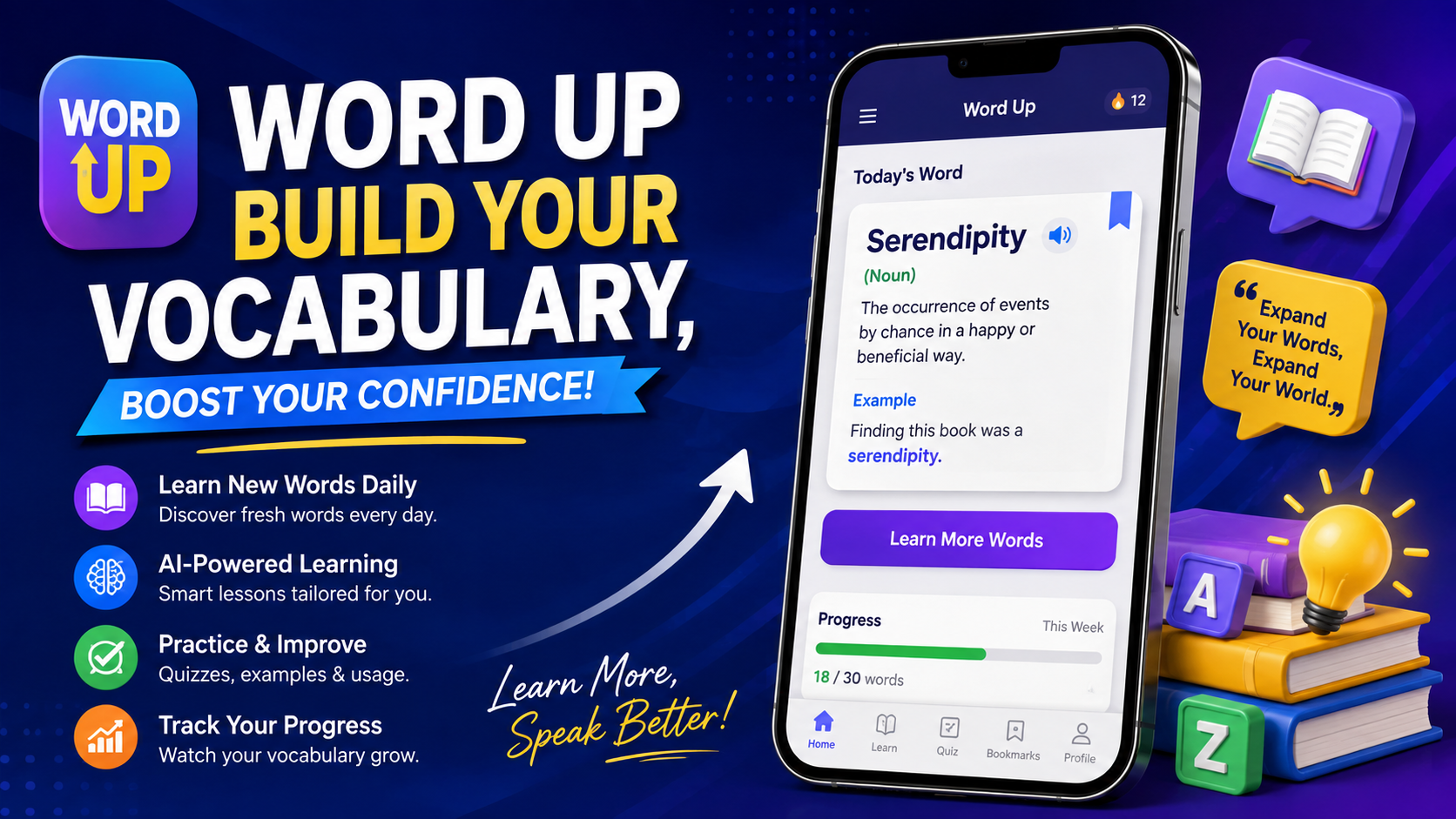
Learning English becomes much easier when you have a strong vocabulary. Whether you are a student, professional, content creator, traveler, or someone who simply wants to communicate more confidently, knowing the right words can make a major difference. This is where Word Up can be useful.
Word Up is an English vocabulary builder app designed to help users learn new English words and improve their vocabulary through regular practice. The application focuses on making vocabulary learning more practical instead of forcing users to memorize long lists of unfamiliar words. According to the description published on Ayaanle.Tech, Word Up is presented as an AI-based English vocabulary builder that helps users learn fresh words daily and improve their English vocabulary.
The idea behind Word Up is simple: learn useful words regularly, understand what they mean, see how they can be used, and gradually build a stronger vocabulary. Consistent vocabulary practice can help learners feel more comfortable when reading, writing, listening, and speaking English.
In this complete guide, we will explore Word Up, its purpose, vocabulary-learning approach, possible benefits, important features, how beginners can use it, and practical tips for getting better results from daily vocabulary practice.
What Is Word Up?
Word Up is an English vocabulary learning application created for people who want to expand their knowledge of English words. Its primary purpose is vocabulary development, with an emphasis on learning new words regularly.
Instead of treating vocabulary as something that can only be learned from traditional textbooks, Word Up provides a mobile-friendly approach to English learning. Users can make vocabulary practice part of their daily routine and gradually become familiar with words that may be useful in everyday communication.
The application is described as an AI-based English vocabulary builder. This makes it particularly interesting for modern learners who prefer technology-supported language learning rather than relying exclusively on conventional study methods.
A strong vocabulary is not simply about knowing thousands of dictionary definitions. Effective vocabulary learning also involves understanding when a word should be used, recognizing it while reading or listening, and eventually being able to use it naturally.
That is why regular practice is important.
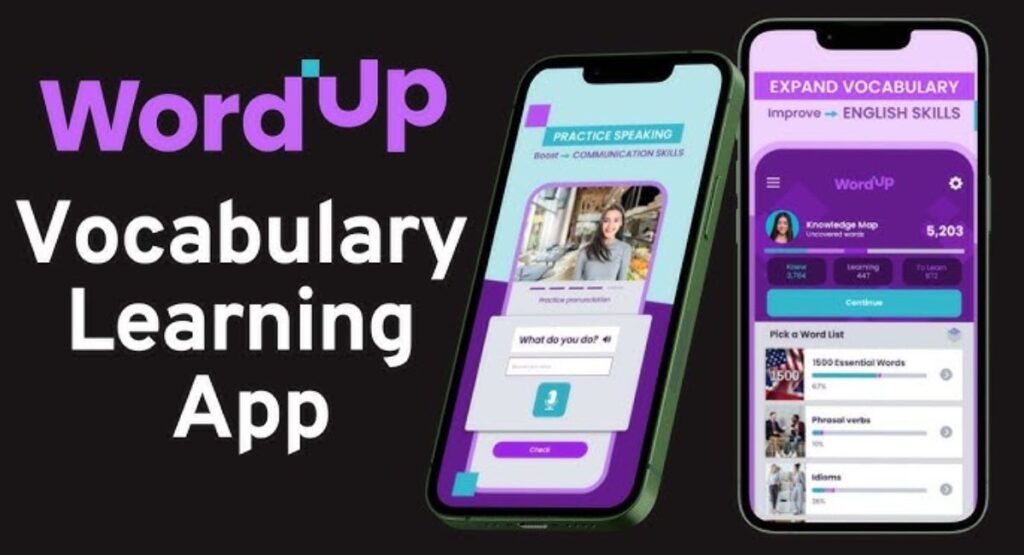
Why Is English Vocabulary Important?
Vocabulary is one of the foundations of language learning. Grammar helps you organize words, while vocabulary gives you the words needed to communicate your ideas.
For example, someone may understand English grammar but still struggle to communicate because they cannot quickly remember the words they need. Expanding vocabulary can help solve this problem.
A larger vocabulary can help with:
- Everyday conversations
- English writing
- Reading comprehension
- Listening comprehension
- Speaking confidence
- Academic study
- Professional communication
- Understanding online content
- Expressing ideas more accurately
- Learning additional English concepts
For students, vocabulary can make reading textbooks and preparing assignments easier. For professionals, better word knowledge can support clearer emails, presentations, and conversations. For casual learners, vocabulary practice can simply make English more enjoyable.
Word Up focuses specifically on this important area of English learning.
Word Up for Daily Vocabulary Practice
One of the most useful approaches to learning a language is consistency. Studying hundreds of words once and then forgetting them is usually less effective than learning smaller amounts regularly.
Word Up is designed around the idea of learning fresh words daily. The daily approach can make vocabulary study feel more manageable because learners can turn a large goal into smaller learning sessions. The Ayaanle.Tech description specifically presents the app as a tool for learning fresh words every day.
A simple daily routine could look like this:
- Open Word Up.
- Learn a small selection of vocabulary.
- Read and understand each word.
- Think about the meaning.
- Try to remember the words later.
- Use new vocabulary in your own sentences.
- Repeat the process consistently.
The exact learning experience can vary depending on the version of the application, but the central idea remains the same: regular vocabulary exposure can support long-term improvement.
Key Features of Word Up
1. English Vocabulary Building
The main purpose of Word Up is vocabulary development. It provides a dedicated environment for learners who want to increase their knowledge of English words.
Instead of mixing vocabulary practice with unrelated functions, the app focuses on the specific challenge of learning and expanding English vocabulary.
2. Daily Word Learning
Daily practice is an important part of the Word Up concept. Learning new words regularly can make vocabulary development feel less overwhelming.
Rather than trying to memorize a huge dictionary at once, learners can focus on consistent progress.
3. AI-Based Vocabulary Learning
The application is described as an AI-based English vocabulary builder.
AI-supported learning can make language education feel more personalized and interactive. For vocabulary learners, technology can help present information in a convenient format and encourage repeated engagement.
4. Focus on Fresh Words
Another important part of Word Up is its focus on discovering fresh English vocabulary. This can be useful for learners who already know basic English and want to move toward a richer vocabulary.
Learning new words can also help users avoid repeatedly using the same simple terms when they communicate.
5. Vocabulary Expansion
The overall goal of Word Up is to help users expand their English vocabulary. Vocabulary expansion is useful because knowing more words provides more choices when expressing thoughts and ideas.
For example, instead of repeatedly using a basic word such as “good,” a learner with broader vocabulary knowledge may eventually understand more precise words that describe quality, effectiveness, usefulness, or excellence.
How Word Up Can Help English Learners
The biggest advantage of a vocabulary-focused application is that it gives learners a dedicated way to work on one of the most important parts of language development.
Better Word Recognition
Regular exposure to vocabulary can help learners recognize unfamiliar words more easily. When the same or related vocabulary appears repeatedly, it may become more familiar.
Improved Reading
A stronger vocabulary can make English articles, books, websites, and educational material easier to understand.
If a reader encounters fewer unknown words, reading can become faster and less frustrating.
Better Writing
Vocabulary also affects writing. Having more words available makes it easier to explain ideas, describe situations, and create more varied sentences.
Speaking Confidence
Many English learners know what they want to say but cannot find the correct words quickly. Vocabulary practice can help reduce this problem over time.
Better Understanding of English
Learning vocabulary is not only about memorizing definitions. It also introduces learners to the different ways English words can communicate ideas.
Word Up for Beginners
Beginners can use Word Up as part of a simple English-learning routine. However, vocabulary learning works best when learners avoid trying to memorize too many words at once.
Start with words that are practical and meaningful.
For every new word, ask yourself:
- What does this word mean?
- How is it pronounced?
- Where might I see this word?
- Can I create my own sentence?
- Is this word formal or informal?
- What other words are related to it?
For example, if you learn a new word related to communication, create a sentence about your daily life using that word.
This makes the vocabulary more meaningful than simply reading a definition.
Word Up for Intermediate English Learners
Intermediate learners can use Word Up to move beyond basic vocabulary.
At this stage, many learners already know common English words but struggle with more precise expressions. Expanding vocabulary can help them communicate ideas with greater variety.
An intermediate learner can focus on:
- Synonyms
- Related words
- More precise expressions
- Academic vocabulary
- Professional vocabulary
- Descriptive vocabulary
- Common expressions
- Words used in different contexts
The goal should not be to use complicated words simply to sound intelligent. Instead, the goal is to understand more words and choose the most appropriate word for each situation.
Word Up for Advanced Learners
Advanced English learners can also benefit from continued vocabulary development.
Even people who communicate comfortably in English can discover unfamiliar words. Languages continue to evolve, and different fields use specialized vocabulary.
Advanced learners can use vocabulary practice to improve:
- Precision
- Writing style
- Professional communication
- Academic English
- Reading speed
- Understanding complex material
- Speaking naturally
For advanced learners, the focus should increasingly shift from simply recognizing words to understanding how those words work in real communication.
How to Build a Daily Word Up Routine
Consistency is more important than studying for a very long time once in a while.
A simple routine can help you make vocabulary learning a habit.
Step 1: Choose a Regular Time
Select a time when you are normally free. Morning, afternoon, or evening can work.
Step 2: Study a Manageable Number of Words
Avoid overwhelming yourself. A smaller number of words studied carefully can be more useful than a huge list that you quickly forget.
Step 3: Understand Each Word
Do not stop at the definition. Think about what the word means and how it could appear in a sentence.
Step 4: Create Personal Examples
Use new words in sentences connected to your own experiences.
Step 5: Review Previously Learned Words
Review is extremely important. New vocabulary becomes more useful when you encounter it repeatedly.
Step 6: Use the Words
Try using newly learned vocabulary when speaking or writing English.
This turns passive vocabulary knowledge into active vocabulary knowledge.
How to Remember New Words More Easily
Memorizing vocabulary can be difficult if you only read definitions. Try combining several learning techniques.
Use Association
Connect a new word with something familiar.
Create a Mental Image
If the word describes an object or action, imagine it visually.
Write Your Own Sentence
Personal examples make vocabulary more memorable.
Say the Word Out Loud
Pronouncing a word can help connect its written form with its sound.
Review Regularly
Return to previously learned words instead of always moving forward.
Use New Vocabulary Naturally
The more often you use a word correctly, the more familiar it can become.
Word Up and English Speaking Practice
Vocabulary and speaking are closely connected.
Imagine that you understand English grammar but only know a limited number of words. You may still find it difficult to participate in conversations.
Vocabulary provides the building blocks for communication.
After learning new words with Word Up, try speaking short sentences that include them. You can talk about your day, your studies, your work, your hobbies, or any other familiar subject.
For example, choose three newly learned words and create a short conversation using all three.
This simple activity can help transform vocabulary from something you recognize into something you can actively use.
Word Up and English Writing
Writing is another area where vocabulary can make a significant difference.
When your vocabulary is limited, you may repeatedly use the same words. This can make writing sound repetitive.
A broader vocabulary gives you more options.
Students can use vocabulary practice when preparing essays, assignments, notes, and presentations. Professionals can benefit when writing reports, emails, proposals, and other workplace documents.
However, vocabulary should always support clarity. Using an uncommon word simply because it sounds impressive can make writing harder to understand.
The best vocabulary is vocabulary that communicates the intended meaning clearly.
Word Up for Students
Students often need English for school, college, university, exams, and online learning.
A vocabulary-building routine can support these activities by helping students become familiar with more English words.
Students can make Word Up part of their revision schedule.
For example:
Morning: Learn new words.
Afternoon: Review the words.
Evening: Write sentences using the vocabulary.
Weekend: Review the entire week’s vocabulary.
This approach keeps vocabulary learning organized and manageable.
Students should also connect new words to their subjects whenever possible. If they are studying business, science, technology, literature, or another field, they can pay attention to vocabulary commonly used in that area.
Word Up for Professionals
Professionals frequently communicate through English.
Depending on the workplace, they may need to read documents, communicate with colleagues, prepare presentations, write reports, or participate in meetings.
Vocabulary knowledge can support these tasks.
For professionals, learning should focus not only on difficult words but also on words that are useful in professional communication.
A good strategy is to learn vocabulary and then practice using it in realistic workplace sentences.
For example, after learning a new word, imagine using it in:
- A business email
- A meeting
- A presentation
- A report
- A professional conversation
This makes vocabulary learning practical.
Common Mistakes When Learning English Vocabulary
Even with a useful vocabulary-learning tool, learners can make mistakes.
Trying to Learn Too Many Words
Studying hundreds of words at once can create unnecessary pressure.
Ignoring Review
Learning a word once does not guarantee long-term memory.
Memorizing Without Context
A dictionary definition alone may not explain how a word is naturally used.
Avoiding Speaking Practice
Vocabulary should eventually become part of active communication.
Focusing Only on Difficult Words
Simple, useful words are often more valuable than rare words.
Giving Up Too Quickly
Vocabulary improvement takes time. Consistency matters.
Tips for Getting Better Results With Word Up
If you want to make the most of Word Up, consider the following strategies.
Make Vocabulary Learning a Habit
Study regularly rather than only when you have free time.
Keep Your Sessions Focused
Short, focused sessions can be easier to maintain.
Review Old Vocabulary
Do not continuously learn new words without revisiting older ones.
Practice Outside the App
Read English content, listen to English conversations, and try using your new vocabulary.
Keep a Personal Vocabulary List
Write down words that are especially useful to you.
Learn From Mistakes
When you forget a word, treat it as an opportunity to review rather than a failure.
Be Patient
Language development is a long-term process.
Is Word Up Useful for Improving English Vocabulary?
For learners specifically looking for a vocabulary-focused English-learning application, Word Up can be a useful option to explore. The app is presented as an AI-based English vocabulary builder with an emphasis on learning fresh words and expanding vocabulary.
However, no single application should be considered the complete solution for mastering English.
Vocabulary works best when combined with other learning activities such as reading, listening, speaking, and writing.
Think of Word Up as one part of your overall English-learning routine.
Word Up: Pros and Considerations
Potential Benefits
- Dedicated focus on English vocabulary
- Daily vocabulary-learning approach
- AI-based learning concept
- Suitable for learners who want to expand their word knowledge
- Can be incorporated into a regular study routine
- Useful for vocabulary-focused practice
Things Learners Should Remember
- Vocabulary learning requires consistency.
- Memorization alone is not enough.
- Words should be practiced in context.
- Speaking and writing practice remain important.
- Different learners may prefer different study methods.
- App features can change between versions.
The goal should always be meaningful English improvement rather than simply collecting a large number of words.
FAQs
What is Word Up?
Word Up is an English vocabulary builder application designed to help users learn new English words and expand their vocabulary. It is described as an AI-based vocabulary learning app.
Is Word Up suitable for beginners?
Yes. Beginners can use a vocabulary-focused learning routine to gradually build their English word knowledge. Starting with manageable learning sessions is recommended.
Can Word Up help improve English vocabulary?
Its primary purpose is vocabulary development, so it can be used as part of a routine focused on expanding English vocabulary.
How often should I use Word Up?
Regular practice is recommended. A daily routine can make vocabulary learning easier to maintain.
Should I only use Word Up to learn English?
No. Vocabulary is only one part of English learning. Reading, listening, speaking, writing, pronunciation, and grammar practice can all contribute to stronger overall English skills.
Can students use Word Up?
Students who want to improve their English vocabulary can include Word Up in their study routine.
How can I remember words learned with Word Up?
Review words regularly, create your own sentences, pronounce them aloud, and use them in real communication.
Is vocabulary important for speaking English?
Yes. Vocabulary gives speakers the words they need to express ideas, explain situations, ask questions, and communicate naturally.
Does learning more words automatically make someone fluent?
Not automatically. Fluency requires several skills, including vocabulary, grammar, pronunciation, listening, speaking, and regular communication practice.
Final Thoughts on Word Up
Building a strong English vocabulary takes time, but the process becomes easier when learning is consistent and organized. Word Up provides a vocabulary-focused approach for people who want to discover fresh English words and gradually expand their vocabulary.
The app’s description on Ayaanle.Tech presents it as an AI-based English vocabulary builder focused on daily vocabulary development.
The most important factor, however, is not simply which vocabulary tool you use. Your results depend heavily on how consistently you practice.
Use Word Up as part of a broader English-learning routine. Learn new words, review them, create your own examples, read English regularly, listen carefully, and use vocabulary in real conversations and writing.
If you make vocabulary practice a daily habit, even small improvements can add up over time.
A stronger vocabulary can give you more ways to express yourself, understand English content, communicate your ideas, and feel confident when using the language.
Word Up is therefore best viewed as a practical vocabulary-learning companion for anyone who wants to make English vocabulary development a regular part of their learning journey.