

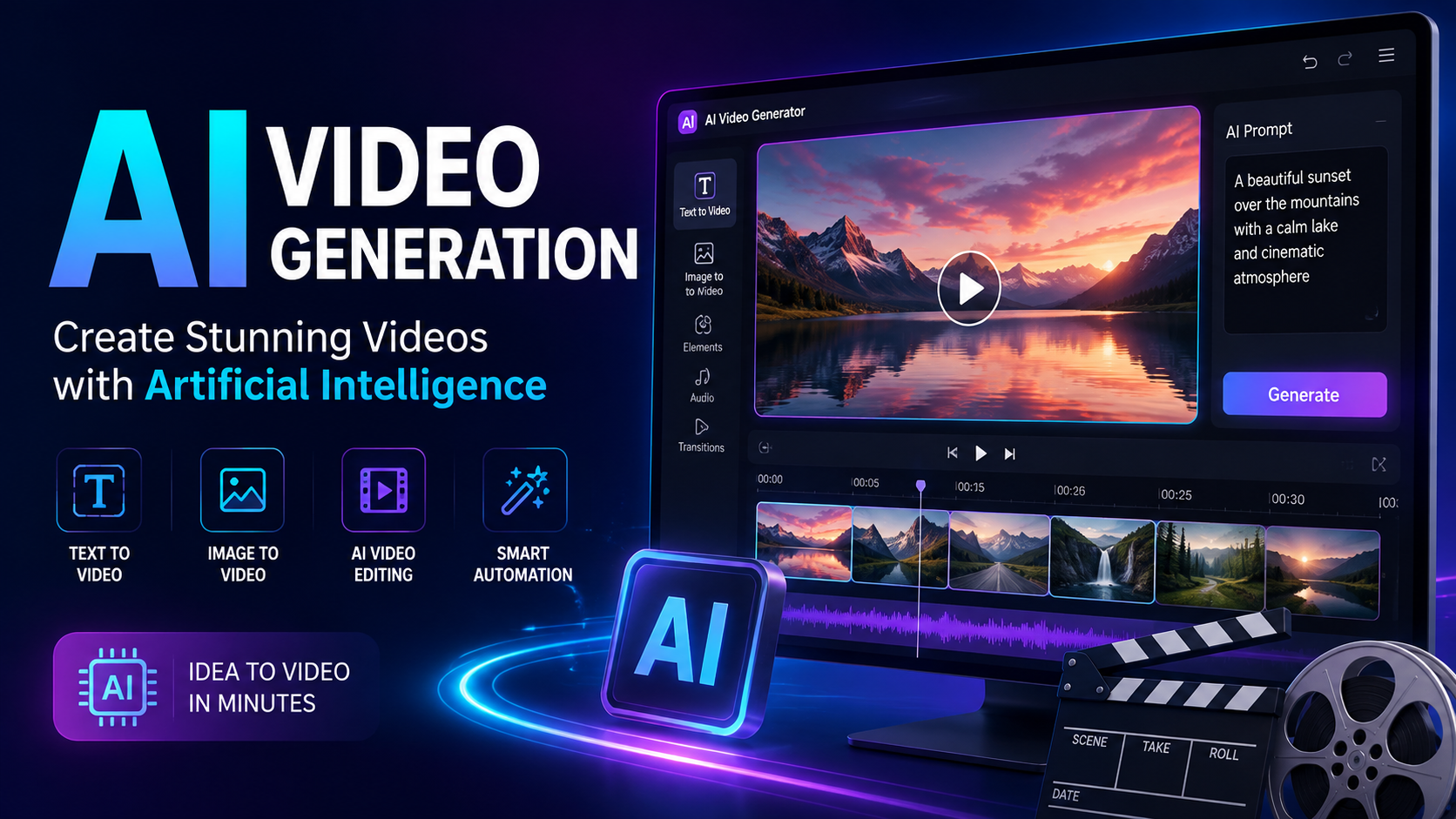
AI Video Generation is changing the way people create, edit, and share video content. In the past, producing a good video usually required a camera, editing software, recording equipment, actors, and plenty of time. Today, artificial intelligence can simplify many of these steps and help creators turn simple ideas into engaging videos.
With AI Video Generation, users can start with text, images, or creative instructions and transform those ideas into video content. This makes video creation more accessible to beginners, content creators, students, marketers, businesses, and anyone who wants to experiment with digital storytelling.
The technology is becoming increasingly useful because video has become one of the most effective ways to communicate online. A short video can explain an idea, demonstrate a product, tell a story, teach a lesson, or entertain an audience more quickly than a long block of text.
AI Video Generation can help reduce the amount of manual work involved in the creative process. Instead of starting everything from an empty timeline, users can use artificial intelligence to generate ideas, create visual scenes, animate images, assist with scripts, and produce video concepts.
This guide explains what AI Video Generation means, how it works, its main features, benefits, limitations, practical uses, and important things to consider before creating AI-powered videos.
What Is AI Video Generation?
AI Video Generation is the process of using artificial intelligence to create or assist with the creation of video content. Depending on the technology being used, AI can generate video from written instructions, animate still images, create visual scenes, assist with editing, or transform existing content into a new video format.
The basic idea is simple. A user provides an instruction or creative concept, and an AI system analyzes that information before producing a visual result.
For example, a creator could describe a peaceful sunset over a mountain landscape. An AI video system may interpret the description and generate a short animated scene based on the requested concept.
AI Video Generation can also work with images. A user may provide a photograph and request movement, camera motion, environmental animation, or another visual effect. The system attempts to turn the static image into a moving sequence.
This technology does not completely replace creativity. Instead, it provides tools that can help people move from an idea to a visual result more quickly.
How Does AI Video Generation Work?
Understanding the basic process makes AI Video Generation easier to use. Although different AI systems use different technologies, the general workflow follows several steps.
1. Start With an Idea
Every video begins with an idea. This could be a story, advertisement, educational explanation, social media clip, product concept, or creative scene.
The more clearly you understand your idea, the easier it becomes to describe what you want the AI system to create.
For example, instead of writing:
“Make a city video.”
You could provide a more detailed instruction:
“Create a cinematic nighttime city scene with modern buildings, glowing lights, moving cars, and a slow camera movement.”
A more detailed description gives the AI more information about the desired result.
2. Write a Clear Prompt
A prompt is an instruction given to an AI system. For AI Video Generation, prompts can describe subjects, environments, movement, lighting, camera angles, mood, and visual style.
A useful prompt may include:
- Main subject
- Location
- Action
- Camera movement
- Lighting
- Atmosphere
- Visual style
- Approximate duration
- Important details
Clear prompts can make the creative process easier because the AI has more information to interpret.
3. AI Interprets the Instruction
After receiving the prompt, the AI analyzes the words and attempts to understand the requested scene.
It identifies important concepts such as objects, people, environments, movements, and visual relationships.
The system then uses its trained models to create a sequence that matches the requested description as closely as possible.
4. Video Generation
The AI produces a video based on the information it has interpreted.
Depending on the system and available features, the result may contain animated objects, camera movement, environmental effects, transitions, or other visual elements.
The quality can vary depending on the prompt, model, input image, requested scene, and complexity of the animation.
5. Review and Improve
The first generated result may not always be perfect.
A creator may need to adjust the prompt and generate another version. This is an important part of AI Video Generation because creating a good result often involves experimentation.
Small changes in wording can sometimes produce noticeably different results.
Main Features of AI Video Generation
AI Video Generation technology can provide a wide range of useful features. The exact features depend on the particular AI system, but several capabilities are becoming common.
Text-to-Video Creation
Text-to-video is one of the most interesting applications of AI Video Generation.
Users can describe a scene using natural language, and the AI attempts to transform that description into a video.
This can be useful for storytelling, concept development, advertisements, educational material, and creative experiments.
Image-to-Video Animation
Another useful feature is image-to-video generation.
Instead of starting with a text description alone, users can provide an image and ask the AI to animate it.
For example, a landscape photograph could be turned into a moving scene with subtle environmental motion and camera effects.
This can give old or static images a new visual life.
AI-Assisted Storytelling
AI can also help creators develop video ideas and stories.
A creator might begin with a simple concept and use artificial intelligence to expand it into scenes, characters, dialogue ideas, or a basic sequence.
This can make the planning stage faster and help beginners overcome creative blocks.
Automated Visual Creation
Traditional video production often requires manually creating or finding visual elements.
AI can assist by generating visual concepts based on instructions. This allows creators to experiment with scenes that may otherwise require significant time and resources.
Creative Effects
AI-powered video systems can also support creative effects and transformations.
Creators can experiment with different moods, environments, animation styles, camera movements, and visual concepts.
This makes AI Video Generation particularly attractive for people who enjoy experimenting with new forms of digital content.
Benefits of AI Video Generation
There are several reasons why AI Video Generation is becoming popular.
Saves Time
Traditional video production can take hours or even days depending on the project.
AI can automate or simplify parts of the process, allowing creators to move from an idea to a visual concept more quickly.
This does not mean every video can be created instantly. Complex projects still require planning, editing, and quality control. However, AI can reduce repetitive work.
Easy for Beginners
Video editing can initially seem complicated.
AI-powered tools can provide a simpler starting point because users can describe what they want rather than manually controlling every element.
Beginners can experiment with prompts and gradually learn how to improve their results.
Supports Creativity
AI Video Generation gives creators another way to explore ideas.
A person may have a concept that would be difficult or expensive to film traditionally. AI can provide a way to visualize that concept.
This is particularly useful during brainstorming and early-stage creative development.
Reduces Production Requirements
Traditional video production may require cameras, locations, lighting, microphones, actors, and editing equipment.
AI does not eliminate the need for these resources in every situation, but it can reduce the requirements for certain types of digital content.
Useful for Different Types of Content
AI-generated video can be used for many purposes, including:
- Educational videos
- Social media content
- Short stories
- Product concepts
- Presentations
- Marketing content
- Demonstrations
- Creative experiments
- Visual explanations
- Promotional material
The flexibility of the technology makes it useful across many industries.
AI Video Generation for Content Creators
Content creators constantly need fresh ideas.
Producing regular video content can become difficult when every video requires filming and editing from scratch. AI can help creators develop concepts, generate visual material, and experiment with different formats.
For example, a creator could use AI to develop a short visual story from a written concept.
Another creator may use AI to animate images and combine them with narration.
The important point is that AI works best when it supports a clear creative strategy. Simply generating random videos may not produce useful content.
Creators should understand their audience and decide what they want each video to accomplish.
AI Video Generation for Businesses
Businesses can also benefit from AI-powered video creation.
Companies need videos for product explanations, promotional campaigns, presentations, internal communication, and online marketing.
AI can help businesses create early concepts quickly and test different creative directions before investing heavily in traditional production.
Small businesses may also find AI useful when they have limited production resources.
For example, a small business could develop a short concept video to explain a service or introduce an idea.
However, businesses should always review AI-generated content carefully before publishing it. Accuracy, branding, copyright, and customer expectations remain important.
AI Video Generation for Social Media
Social media platforms are highly visual, which makes video an important format for creators and brands.
Short videos can capture attention quickly and communicate information in a compact format.
AI Video Generation can help creators experiment with different video concepts, visual hooks, storytelling techniques, and presentation styles.
A strong social media video should still have a clear purpose.
The first few seconds should provide a reason for viewers to continue watching. The message should remain focused, and the visual content should support the topic.
AI can help with production, but good content still depends on understanding the audience.
How to Create Better AI Videos
Getting good results from AI Video Generation requires more than writing a few words.
Be Specific
Detailed prompts generally provide better creative direction.
Instead of saying:
“Create a beautiful video.”
Try describing the subject, environment, action, mood, and camera movement.
For example:
“Create a peaceful cinematic scene of a quiet beach at sunrise, with gentle waves, warm morning light, soft clouds, and a slow camera movement toward the horizon.”
The second instruction gives the AI much more information.
Keep One Main Idea
Overloading a prompt with too many unrelated instructions can make the result confusing.
Focus on one primary scene or concept.
If your project contains several scenes, consider developing them separately and combining them during editing.
Experiment With Prompts
Do not expect the first result to be perfect.
AI Video Generation is often an iterative process. Generate a version, identify what needs improvement, modify the instruction, and try again.
Describe Movement Clearly
Video is different from an image because movement matters.
If you want an object to move, describe the action.
You can also explain camera movement, such as:
- Slow zoom
- Camera pan
- Tracking movement
- Forward movement
- Gentle rotation
- Static camera
Clear movement instructions can help communicate your visual intention.
Review Every Result
Always watch the complete generated video before publishing it.
Look for visual errors, unnatural movement, incorrect objects, strange transitions, inconsistent details, or other problems.
Human review remains important even when AI handles much of the production process.
Common Challenges of AI Video Generation
Although AI Video Generation is powerful, it has limitations.
Inconsistent Results
The same prompt may not always produce identical results.
AI-generated content can vary between generations, so creators may need several attempts.
Visual Errors
AI systems can sometimes produce unusual or incorrect details.
Hands, faces, objects, text, motion, and complex interactions may not always appear correctly.
Limited Control
Traditional video editing gives creators detailed control over individual elements.
AI generation may provide less precise control, depending on the system.
Processing Requirements
Generating video can require significant computing resources. Some systems may also take longer to process complex requests.
AI Does Not Replace Human Creativity
AI can generate content, but it does not automatically understand your audience, goals, brand identity, or personal creative vision.
The best results usually come when humans guide the process and AI assists with production.
AI Video Generation and the Future of Content Creation
The future of AI Video Generation is likely to involve more realistic visuals, improved motion, better consistency, stronger editing capabilities, and easier creative controls.
As the technology develops, creating a video may become more similar to describing an idea.
Instead of manually adjusting every technical setting, creators may increasingly communicate their goals using natural language.
This could make video production accessible to more people.
However, human creativity will remain important. A powerful generation system can create visual material, but creators still need to decide what story to tell, why it matters, and who should see it.
The future is therefore more likely to involve collaboration between humans and AI rather than complete replacement of human creativity.
Responsible Use of AI Video Generation
Using AI responsibly is important.
Creators should avoid misleading audiences with fabricated content presented as real events. They should also respect privacy, intellectual property, and the rights of individuals.
When creating videos involving real people, creators should consider whether they have appropriate permission to use their identity or likeness.
AI-generated videos should also be reviewed for misleading information, especially when they involve news, education, public figures, or sensitive subjects.
Responsible use helps protect audiences and supports a healthier digital environment.
Is AI Video Generation Good for Beginners?
Yes, AI Video Generation can be a useful starting point for beginners.
A beginner does not need to understand every technical part of video production before experimenting with AI.
Start with simple concepts.
Create short scenes, test different prompts, compare results, and learn what types of instructions produce better outcomes.
Over time, beginners can combine AI generation with traditional editing skills.
Learning basic storytelling, pacing, composition, audio, and editing can make AI-generated videos much more effective.
AI Video Generation vs Traditional Video Creation
Traditional video creation remains valuable and is still the best option for many projects.
Traditional production provides detailed control over actors, locations, cameras, lighting, sound, and physical environments.
AI Video Generation provides a different approach.
It is particularly useful when speed, experimentation, visualization, or reduced production requirements are important.
Neither method is automatically better for every situation.
A creator should choose the method based on the project’s goals.
In many cases, the strongest workflow may combine AI-generated elements with human filming and traditional editing.
Tips for Getting Professional-Looking Results
If you want better results from AI Video Generation, follow these practical tips:
- Start with a clear concept.
- Write specific prompts.
- Describe movement instead of only describing objects.
- Keep scenes focused.
- Experiment with multiple versions.
- Review every generated clip.
- Edit the final video carefully.
- Use suitable audio.
- Keep your target audience in mind.
- Avoid publishing unreviewed AI output.
Quality is not simply about how advanced the AI model is. Good planning and human editing can make a significant difference.
FAQs
What is AI Video Generation?
AI Video Generation is the use of artificial intelligence to create or assist with video content. It can transform text or images into moving visual scenes and help with different parts of video production.
Can beginners use AI Video Generation?
Yes. Many AI-powered video systems are designed to make video creation easier for people without advanced editing experience.
Can AI create a video from text?
Yes, text-to-video technology allows users to provide written descriptions that an AI system can use to generate video content.
Can AI animate a photograph?
Yes, image-to-video technology can animate still images and add movement or camera effects.
Is AI-generated video always perfect?
No. AI-generated videos can contain visual inconsistencies, unnatural movements, or incorrect details. Reviewing and editing the result is important.
Does AI Video Generation replace video editors?
Not completely. AI can automate some tasks, but human editors still provide storytelling, judgment, creative direction, quality control, and detailed editing.
How can I improve AI video results?
Use clear and detailed prompts, describe movement, keep scenes focused, experiment with different instructions, and review the generated content before publishing.
Is AI video useful for social media?
Yes. AI can help creators develop short visual content, creative concepts, promotional material, and other formats suitable for online audiences.
Final Thoughts
AI Video Generation is making video creation more accessible, flexible, and experimental. What once required extensive equipment and technical knowledge can now be approached through simple creative instructions and AI-powered workflows.
The biggest advantage is not simply automation. It is the ability to turn ideas into visual concepts faster.
For beginners, AI can provide an easier way to explore video creation. For experienced creators, it can become another tool in the production process. For businesses, it can support marketing, presentations, product concepts, and communication.
At the same time, creators should understand that AI-generated content still requires human direction and review. A good video needs a clear purpose, strong storytelling, suitable visuals, and attention to quality.
The future of video creation will likely combine artificial intelligence with human creativity. As AI Video Generation technology continues to improve, creators will have more opportunities to experiment, tell stories, and produce engaging visual content.
The best approach is to treat AI as a creative assistant rather than relying on it blindly. Start with a strong idea, write a clear prompt, generate different versions, review the results, and refine the final video.
With the right workflow, AI Video Generation can become a powerful part of modern digital content creation.