

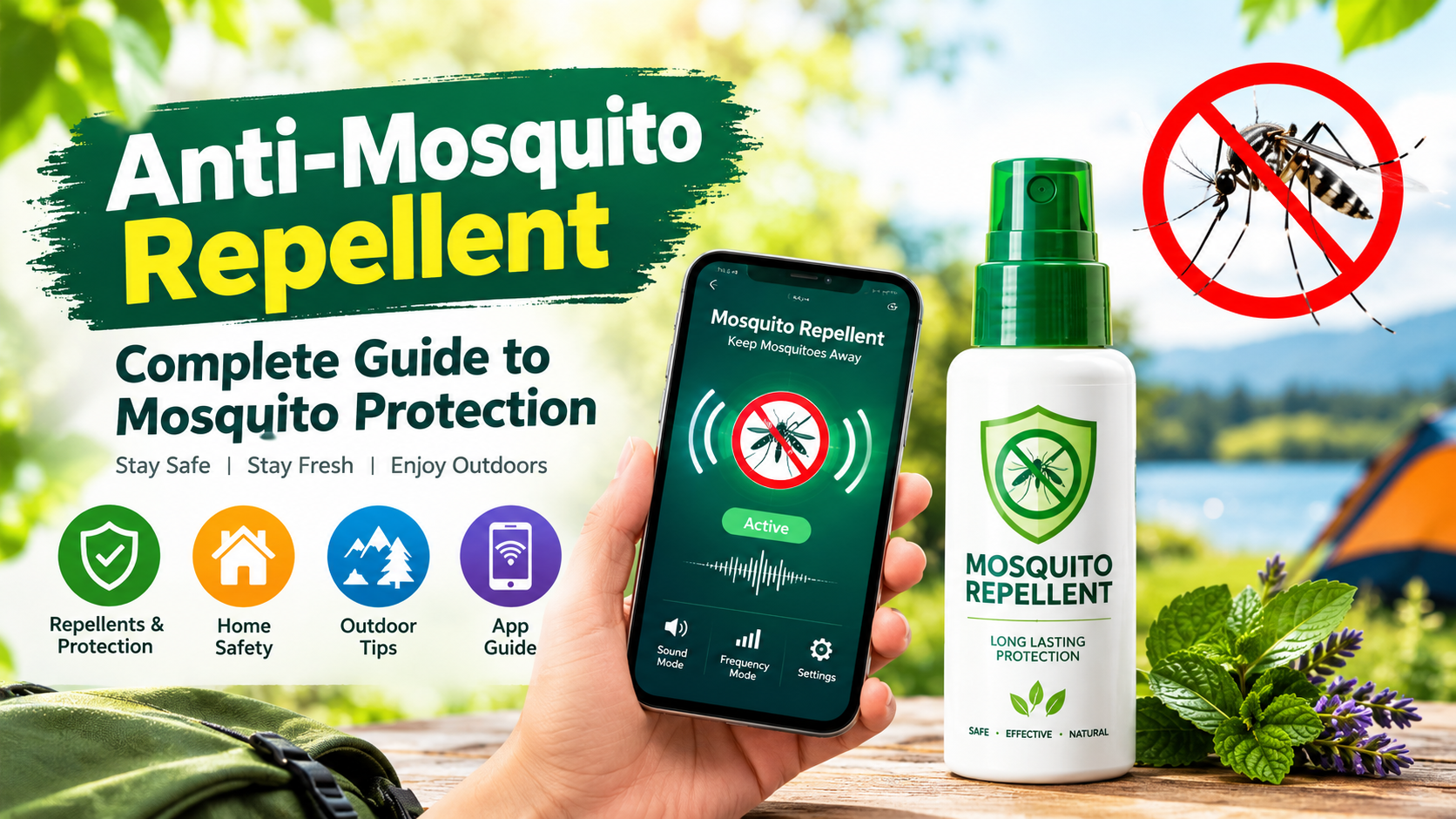
Mosquitoes are among the most common insects people want to keep away from their homes, bedrooms, gardens, and outdoor spaces. Their bites can cause itching and irritation, while some mosquito species can spread diseases. Because of this, choosing the right Anti-Mosquito Repellent approach is an important part of everyday mosquito protection.
Modern mosquito protection includes several different methods. These can include skin-applied repellents, protective clothing, window and door screens, mosquito nets, environmental control, and products designed for outdoor areas. There are also smartphone applications that claim to discourage mosquitoes through sound or high-frequency signals. However, users should understand the difference between a convenient app and a scientifically established mosquito-control method.
This complete guide explains what an Anti-Mosquito Repellent solution is, how mosquito repellents work, how to use them correctly, what to look for when selecting a product, and why combining several prevention methods can provide better protection.
What Is an Anti-Mosquito Repellent?
An Anti-Mosquito Repellent is a product, method, or technology intended to discourage mosquitoes from landing on or biting people. Repellents do not necessarily kill mosquitoes. Instead, many repellents work by making a person less attractive to mosquitoes or interfering with the insect’s ability to locate and approach the person.
Common mosquito protection options include topical repellents, treated clothing, mosquito nets, screens, spatial repellents, and environmental mosquito-control methods. The right option depends on where you are, how long you will be outside, mosquito activity, and the product instructions.
The term Anti-Mosquito Repellent can therefore describe more than one type of solution. A topical repellent may be applied to exposed skin, while a spatial product may be designed to create a repellent area. Other approaches focus on preventing mosquitoes from entering a building or eliminating locations where they can reproduce.
For reliable protection, it is important to select a method with evidence supporting its intended use rather than assuming every mosquito-related device or application works equally well.
Why Mosquito Protection Matters
Mosquito bites are more than a minor nuisance. Some mosquito species can transmit germs that cause illnesses, including dengue, West Nile disease, Zika, chikungunya, yellow fever, and other mosquito-borne infections depending on the region.
The CDC recommends using EPA-registered insect repellents and combining bite prevention with other measures such as long clothing, screens, and mosquito-control practices.
An Anti-Mosquito Repellent can be one part of a broader prevention strategy. No single method should be considered a universal solution for every environment. Outdoor activities, tropical climates, standing water, open windows, and nighttime mosquito activity can all increase exposure.
That is why mosquito prevention works best when several practical measures are used together.
How Mosquito Repellents Work
Different mosquito repellents work in different ways.
Skin-applied repellents generally contain an active ingredient that makes it more difficult for mosquitoes to detect or approach a person. According to CDC guidance, commonly recommended active ingredients include DEET, picaridin, IR3535, oil of lemon eucalyptus, para-menthane-diol, and 2-undecanone, depending on the product and intended use.
An Anti-Mosquito Repellent product should always be used according to its label. The amount, application method, duration of protection, and reapplication instructions can differ between products.
Some products are designed for clothing or gear rather than direct skin application. Permethrin-treated clothing, for example, can provide mosquito protection, but permethrin products intended for clothing should not be applied directly to skin.
Spatial repellents use a different approach. EPA explains that some spatial products use heating or dispersal mechanisms to distribute repellent substances through an area. These products may include lanterns, diffusers, candles, or coils, but their approved use depends on the product label.
Anti-Mosquito Repellent Apps and Sound
One reason mosquito-related smartphone applications attract attention is their simplicity. A user can install an application, open it, and activate a sound or frequency intended to discourage insects.
The original page associated with this topic describes an Anti-Mosquito Repellent application that produces a special frequency that users may not hear. This concept is often marketed as an easy alternative to conventional mosquito protection.
However, sound-based mosquito applications should not be presented as a scientifically proven replacement for established repellents. The EPA notes that devices relying on sound waves are not registered as insect repellents in the same way as evaluated repellent products, and EPA does not know whether such devices are effective against mosquitoes.
This distinction is important for anyone researching an Anti-Mosquito Repellent app. An application can be interesting to test, but users should not depend on an unverified sound-frequency app as their only protection against mosquito bites.
For people concerned about mosquito-borne disease, evidence-based prevention should remain the priority.
Features to Look for in an Anti-Mosquito Repellent
When evaluating an Anti-Mosquito Repellent, look beyond advertising claims. Useful factors include the active ingredient, intended application area, protection duration, safety instructions, and regulatory information.
1. Clearly Identified Ingredients
For topical products, check the active ingredient and concentration listed on the label. Ingredients such as DEET and picaridin are among the options recommended by public-health authorities when used according to directions.
2. Clear Usage Instructions
A quality Anti-Mosquito Repellent should provide clear directions. Users should know where the product can be applied, how much to use, and when it should be reapplied.
3. Appropriate Protection Duration
Different products provide different lengths of protection. Physical activity, sweating, water exposure, temperature, and other conditions can influence how long a repellent remains effective. EPA recommends following the product label for application and reapplication.
4. Suitable Application Area
Not every repellent is designed for skin. Some are made for clothing, equipment, indoor areas, or outdoor spaces. Never assume that a product intended for one application area is suitable for another.
5. Safety Information
A trustworthy Anti-Mosquito Repellent should have understandable safety instructions. Products should be stored safely, particularly around children, and users should follow all label directions.
How to Use an Anti-Mosquito Repellent Correctly
Correct use is just as important as choosing a good product.
For a topical Anti-Mosquito Repellent, read the label before application. Apply only the recommended amount to exposed skin and avoid areas where the product should not be used.
Do not apply repellent beneath clothing unless the product specifically says that it is designed for that purpose. CDC guidance also recommends applying sunscreen first and insect repellent afterward when both are needed.
When using repellent on children, additional care is necessary. Adults should follow the product instructions and avoid applying repellent to a child’s hands, eyes, mouth, cuts, or irritated skin. CDC specifically advises that oil of lemon eucalyptus and PMD products should not be used on children under three years old.
Always wash your hands after applying products when appropriate, and follow the manufacturer’s directions for removing or washing off the repellent.
Anti-Mosquito Repellent for Indoor Protection
Mosquitoes can enter houses through open windows, doors, damaged screens, and other openings. An Anti-Mosquito Repellent can help as part of an indoor protection strategy, but physical barriers are also extremely useful.
Install or maintain screens on windows and doors. Repair holes that allow mosquitoes to enter. Using air conditioning, where available, can also reduce exposure by allowing doors and windows to remain closed.
Mosquito nets can be especially useful when sleeping in areas where mosquitoes are common. They provide a physical barrier between the person and the insects.
Indoor mosquito protection should also involve identifying areas where mosquitoes may be resting or entering. Keeping doors closed when possible and removing standing water around the property can further reduce mosquito activity.
Anti-Mosquito Repellent for Outdoor Activities
Outdoor environments can expose people to substantially more mosquitoes, especially around vegetation, water, shaded areas, and places where mosquitoes rest.
Before going outside, choose an Anti-Mosquito Repellent appropriate for the activity. Hiking, camping, gardening, traveling, and spending time near water may require different protection strategies.
Wear loose-fitting, long-sleeved shirts and long pants when practical. CDC recommends protective clothing and notes that permethrin-treated clothing and gear can provide additional protection.
Apply a suitable repellent to exposed skin according to its instructions. If you will be swimming or sweating heavily, check the product label for guidance regarding water exposure and reapplication.
Outdoor spatial repellents can sometimes be useful where their labels permit that type of use. EPA emphasizes that users should read the label to understand coverage, wind limitations, and whether a product is intended for indoor or outdoor use.
Removing Standing Water
Using an Anti-Mosquito Repellent is only one part of mosquito prevention. Removing breeding opportunities can reduce the number of mosquitoes around your property.
Mosquitoes can use surprisingly small amounts of standing water. Containers, buckets, plant saucers, discarded tires, toys, drains, and other objects can collect water.
CDC recommends checking for water-holding containers around homes and emptying, scrubbing, turning over, covering, or removing them regularly.
Make mosquito prevention part of your weekly household routine. Check outdoor areas after rainfall and remove water that has accumulated in containers.
Reducing breeding locations can complement an Anti-Mosquito Repellent strategy because fewer mosquitoes around your home can mean fewer opportunities for bites.
Natural Mosquito Repellents
Many people search for natural ingredients because they want alternatives to conventional products. Some plant-derived ingredients can be used in registered mosquito repellents, but the term “natural” does not automatically mean effective or safe.
CDC notes that the effectiveness of non-EPA-registered insect repellents, including some natural repellents, may be unknown.
For this reason, consumers should avoid assuming that every essential oil, homemade mixture, bracelet, candle, or plant automatically provides dependable protection.
If choosing a plant-derived Anti-Mosquito Repellent, check the product label and look for appropriate registration or evidence supporting its intended use.
Pure essential oils should not automatically be treated as equivalent to formulated insect repellents. Formulation, concentration, application method, and safety testing can all matter.
Are Mosquito Repellent Apps Worth Trying?
A smartphone Anti-Mosquito Repellent application can be easy to install and may be interesting for users who want to experiment with sound-based technology.
However, convenience should not be confused with proven effectiveness. If an application claims that a particular frequency will keep mosquitoes away, users should look for independent scientific evidence rather than relying only on the application’s description.
The safest approach is to treat an unverified mosquito app as an optional experiment rather than a replacement for established bite-prevention measures.
If mosquito-borne disease is a concern, use recommended repellents, protective clothing, screens, nets, and environmental control measures. These approaches have much stronger support from public-health authorities.
Common Mistakes When Choosing an Anti-Mosquito Repellent
Several mistakes can reduce mosquito protection.
One common mistake is selecting a product only because it claims to be “natural” or “chemical-free.” Another is assuming that a smartphone sound app provides the same protection as an evaluated insect repellent.
A third mistake is failing to read the label. Even an effective Anti-Mosquito Repellent may provide less protection when it is used incorrectly.
Overusing repellent is another problem. More product does not necessarily mean better protection. EPA advises users to apply and reapply products according to the label rather than using excessive amounts.
People should also remember that repellent alone does not remove mosquitoes from an environment. Standing water, damaged screens, open doors, and outdoor resting areas can continue to support mosquito populations.
Anti-Mosquito Repellent and Travel
Travelers should pay particular attention to mosquito protection when visiting places where mosquito-borne diseases are common.
Pack a suitable Anti-Mosquito Repellent before traveling and check its active ingredient and usage instructions. Protective clothing and mosquito nets may also be useful depending on the destination.
CDC recommends EPA-registered repellents for travelers and identifies several active ingredients that can provide protection when used as directed.
Travelers should also consider local health guidance because mosquito species and disease risks differ between regions.
Safety Tips for Families
Families should select an Anti-Mosquito Repellent carefully, particularly when children will use or be around the product.
Read the label before use. Keep repellent products away from children’s reach when they are not being used. Avoid applying products to children’s hands, eyes, mouths, or damaged skin.
Do not assume that an adult product is automatically appropriate for young children. Follow age restrictions and application instructions.
For babies, physical protection can be particularly important. CDC recommends clothing that covers arms and legs and mosquito netting for strollers and baby carriers.
Anti-Mosquito Repellent: Best Protection Strategy
The most effective approach is usually not one single product. Instead, combine several prevention techniques.
Start by reducing mosquito breeding locations around your home. Then improve physical barriers such as screens and nets. When outdoors, wear suitable clothing and use a proven Anti-Mosquito Repellent according to its label.
If you are using an outdoor spatial product, make sure it is approved for the environment where you intend to use it. EPA advises checking the product label for coverage and indoor or outdoor restrictions.
This layered strategy addresses mosquitoes at several stages: reducing their breeding opportunities, preventing them from entering buildings, creating physical barriers, and reducing the chance of bites.
See Also: https://ayaanletech.org/find-face/
FAQs
What is the best Anti-Mosquito Repellent?
The best option depends on your situation. For personal bite protection, CDC recommends EPA-registered repellents containing recognized active ingredients such as DEET, picaridin, IR3535, OLE/PMD, or 2-undecanone, depending on the product and intended user.
Do Anti-Mosquito Repellent apps really work?
Sound-based mosquito apps should not be treated as proven replacements for established repellents. EPA states that sound-wave devices are not registered as insect repellents and that EPA does not know whether they are effective against mosquitoes.
Can I use mosquito repellent every day?
Some repellents can be used regularly when used according to their labels. Always follow the product instructions, including application amount and reapplication frequency.
Is DEET safe?
EPA and CDC recognize DEET as an effective mosquito-repellent ingredient when products containing it are used according to their labels.
Is picaridin effective against mosquitoes?
Picaridin is one of the active ingredients identified by CDC as an effective option in EPA-registered insect repellents.
Can natural repellents prevent mosquito bites?
Some plant-derived ingredients can be used in formulated repellents, but not every natural product has demonstrated effectiveness. CDC cautions that the effectiveness of non-registered natural repellents may be unknown.
How can I reduce mosquitoes around my home?
Remove standing water, maintain window and door screens, keep outdoor areas clean, and follow appropriate mosquito-control practices. Removing breeding sites is an important part of mosquito management.
Does wearing long clothing help?
Yes. CDC recommends loose-fitting, long-sleeved shirts and pants as part of mosquito bite prevention.
Should I rely only on an Anti-Mosquito Repellent app?
No. If the application uses sound or frequencies without established evidence, it should not be considered your only protection. Combine proven prevention methods instead.
Final Thoughts
An Anti-Mosquito Repellent can be an important part of a practical mosquito-protection routine, but users should understand what different products can and cannot do.
Smartphone applications that generate mosquito-related sounds may be convenient, but claims about their effectiveness should be approached carefully. There is a significant difference between a technology being advertised as a repellent and a product having evidence and regulatory evaluation supporting its intended use.
For dependable protection, focus on proven strategies: use an appropriate registered repellent according to its label, wear protective clothing, maintain screens and mosquito nets, and remove standing water around your home. CDC and EPA both emphasize combining bite prevention with broader mosquito-control measures.
The best Anti-Mosquito Repellent strategy is therefore a layered one. Instead of depending on a single application, device, or household trick, combine personal protection with environmental prevention.
Whether you are relaxing at home, working outdoors, traveling, camping, or spending an evening in the garden, understanding how mosquito prevention works can help you make better decisions. Choose products carefully, read their labels, avoid unsupported claims, and use multiple protective measures when mosquito exposure is high.
With the right approach, an Anti-Mosquito Repellent can become one useful component of a broader mosquito-bite prevention plan.